Thursday, October 1, 2009

"Genghis Lords of the Bow"--by Conn Iggulden


Genghis Lords of the Bow, by Conn Iggulden, is an exciting portrayal of the Mongols’ influence on the world during the 1200s. Genghis Khan built a huge empire ranging from Eastern Europe to China and South to India (almost all of Asia!). The Mongol warriors relied on small, but strong mongolian ponies, training toughly by using bow and arrow while riding fast and drinking their horses’ blood for quick sustenance. With these relatively primitive tactics, along with looting nearby settlements for supplies, they created a huge empire that should be recognized in the history textbooks more because the Mongols really changed history.


In writing the novel, Conn Iggulden may have hoped to make the Mongols’ impact on the world more known to people because without the Mongols’ influence, our world (especially Asia) may not be as diverse as it is now. When Genghis ruled, his leadership was strong and ruthless to maintain stability, but he allowed incredible toleration for other races and religions! He ensured a safe trading along the Silk Road, previously infested with ambushing barbarians and pirates. All these actions encouraged a cultural diffusion boom with different peoples, especially a mix between European and East Asian cultures. Can you imagine what the world would be like if the Europeans never had had contact with East Asia? Mixed European/East Asian races would not exist. Our world would be boring and plain; there would be less cultural interaction we see in Asia today. Asian continental trade would not be as vast as today’s diverse trade network.

If not for Genghis Khan, say ‘Goodbye’ to your present lifestyle. Without Genghis, a brutal ruler could have arisen to power and terrorized the world for an indeterminate amount of time.

Thursday, September 24, 2009

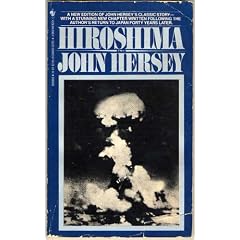
Hiroshima-by John Hersey

This book is very gruesome, but vivid and accurate. Author John Hersey investigates Japan during and the months after the atomic bomb explosion on Hiroshima. A part that really shocked me was the part, after the explosion, a survivor was helping a woman move away from a flooding river. He was pulling her arms when suddenly her skin fell right off. I had an image of exposed muscles and blood vessels. I never expected this. So not only are the initial flash burns from the bomb severe, but all the health issues after the explosion are just as horrible.

Thinking as positively as I could about this situation, I was cheering all the survivors’ valor. For example, as weak as Dr. Sasaki was, he managed to treat thousands of patients at the Red Cross Hospital, until he was forced to sleep minimal hours. I have no idea how it feels to work continuously for 3 days straight WITHOUT sleeping. Praise him!

In American History courses, much more time should be devoted to the explosion of the atomic bomb and the after effects. We skim over how the Japanese were affected; instead, we should look at more case studies of specific people or of specific ways the people were affected in DETAIL! Since we dropped the bomb, we should fully understand the repercussions and what we caused by dropping the bomb; families were instantly torn apart. A traditional, bustling economy was instantly transformed to ashes when the bomb detonated at 8:15 am (local time) August 6, 1945. In short, by dropping the bomb, we saved thousands of American soldiers’ lives which otherwise may have died in an extension of the war, but we must remember that by saving our lives, we killed thousands of possibly innocent Japanese civilians.

Sunday, September 13, 2009

Flags of our Fathers-by James Bradley

Flags of our Fathers, by James Bradley, is a non-fiction book that accurately depicts the fighting of the U.S soldiers against the Japanese soldiers in World War II, specifically during the Battle of Iwo Jima, one of the Japanese strongholds in the Pacific. The mountainous terrain and the technology of rapid machine gun fire made the fighting almost impossible to win. As I read the book, I was horrified by the savage techniques used by the U.S. The soldiers had to resort to flame throwers in order to kill and slowly conquer the island. In any other war, using fire would have been over-the-top but in this war, since the Japanese were hiding and shooting from underground tunnels, the U.S had to use whatever they could think of to drive the Japanese out. This book is full of valorous moments, especially with the corpsmen running through cross-fire to save wounded soldiers. If I ever had to fight in a war because of a draft, I would do my duty to my country but I probably would be too scared to attempt anything extra--especially saving others’ lives. I would rate this book a 10 out of 10 because of the high amount of patriotism (especially the climax when raising the U.S flag on the highest point of Iwo Jima under surprise ambushes) of the soldiers. Anyone who loves war and history books, Flags of our Fathers is for you.

Ragtime-by E.L Doctorow

Ragtime, by E.L Doctorow, is a challenging book, in terms of vocabulary and content. Ragtime weaves together powerful themes such as poverty, family, anarchy, racism, love, and restlessness. This book captures the revelry of the early 1900s. In the book, I was angered when a black man’s car was vandalized by a white volunteer fire department. Racism toward blacks during this time is widespread toward both poor and well-to-do blacks. If racism between the two groups is this widespread, then in the 1960s, it probably was at an intolerant level (something had to be done to fix racism). Furthermore, it was very considerate of a white family to take in a black woman and offer her hospitality. At least there are some people who do not let racism blind their judgement and instead remain kind and welcoming to all races. This book may be hard to read, but one could put oneself in many of the situations and experience how the characters feel.