Sunday, October 8, 2017

Sunday, July 23, 2017
Saturday, July 22, 2017
Saturday, June 24, 2017
Saturday, April 1, 2017

Sunday, January 8, 2017

Saturday, September 17, 2016

Saturday, August 20, 2016
Sunday, August 14, 2016

Monday, July 4, 2016

Saturday, April 23, 2016
Saturday, June 20, 2015
Thursday, January 8, 2015
Saturday, November 29, 2014

Wednesday, October 15, 2014

Wednesday, January 15, 2014

Tuesday, January 7, 2014

Monday, January 6, 2014

Thursday, January 2, 2014

Tuesday, December 31, 2013

Saturday, August 3, 2013

Monday, July 29, 2013

Wednesday, July 3, 2013

Monday, August 27, 2012

Friday, May 27, 2011
Monday, May 9, 2011

Sunday, May 8, 2011

Sunday, March 13, 2011

Wednesday, February 16, 2011

Sunday, December 26, 2010

Sunday, November 28, 2010

Friday, October 29, 2010

Thursday, September 16, 2010

Friday, September 3, 2010
The Picture of Dorian Gray-by Oscar Wilde--SUMMER READING BOOK 4
Picked up this book in 10th grade: was uninterested. Picked up this book now (after reading challenging 11th grade English books): liked it so much more!!! I now appreciated the themes of beauty, desire, rash emotions, and human nature tremendously after I read The Great Gastsby. In fact, I enjoyed this book because of its subtle suspense leading up to the dramatic, tragic ending. This book has helped me to begin a quest to read ever-more mind-provoking books (my next book: This Side of Paradise by F. Scott Fitzgerald). In The Picture of Dorian Gray, I was captivated and drawn into the tranquil, carefree, innocent backdrop of London in the 1890s, the setting of the story, by Oscar Wilde's magnificent poetic descriptions of the natural world and beauty. This book was full of paradoxes describing the stark, almost gloomy nature of beauty. In all, this was a great book to start off a challenging year in 12th grade English.


Thursday, August 19, 2010
American Buffalo-by David Mamet-SUMMER READING #3
This was my first experience with reading drama on my own. I felt this play was the best book to begin my exposure to drama. Despite its short length, the play stressed ideas of the American Dream, innocence, and deception. This play was perfectly suited to my reading level because I enjoyed interpreting the deeper meanings of these quintessential themes that repeat so much throughout American literature (e.g. The Great Gatsby). One challenge I had with this play was that some parts were a little vague/ambiguous. However, I soon found out the information sooner or later (unlike in prose where it is easier to explain an idea right then and there). I would definitely recommend this book to anyone interested in reading drama for the first time as part of independent reading.


Thursday, August 5, 2010
A Hope in the Unseen-by Ron Suskind: SUMMER READING BOOK 2
I finally have a better picture of what it feels like for kids to attend poor functioning schools. I was especially amazed by the determination and bravery of Cedric Jennings, the protagonist, when he took a course at MIT and then attended college at Brown University. I realize now that I have so many more advantages and a lot more sheltering than Cedric did. He had to brave drug dealers and gun threats in the dangerous pockets of Washington D.C. Throughout this book, I was truly enlightened by all of Cedric's experiences, including visiting his incarcerated father, a peek into Ivy League life, and the troubles at his house. With a tough childhood, for Cedric to get into a top school is unbelievable. I would recommend this book to anyone with an interest in a story about challenge and achievement (by the way, this shockingly was nonfiction!!).


Wednesday, June 30, 2010
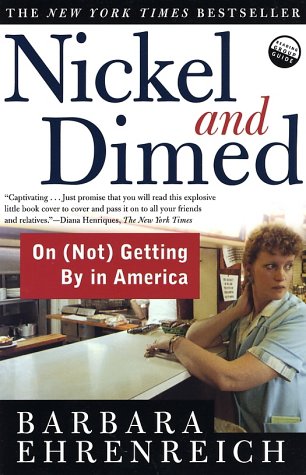
Nickel and Dimed (On (Not) Getting by in America)-by Barbara Ehrenreich: SUMMER READING BOOK 1
I was horrified when I read this book. I never truly understood how degrading and miserable the lives of the working class were. Now, however, I finally understand clearly why working class members are so miserable on the job; wages are the problem. Yet they do not rebel against their managers because they are so desperate for money. Also, I cannot begin to imagine how I could enjoy my life living on $6 an hour wages (below the minimum wage). This means that I must eat only very simple foods, such as grains, and cannot eat much meat. I also will not be able to support a family or take vacations because I will have to spend all my money on necessities. I would hate living from paycheck to paycheck because I would not like to be dependent solely on my job. If for some reason I lose my job, I could easily go bankrupt. Due to this plain, mundane, impoverished lifestyle, I am motivated even more (I am already!) to excel in school, enter college, and find a job that pays well so I can continue to live the affluent, relaxing life I live now.
In addition, one profession mentioned in this book that provoked sympathy from me was maid service. Maids have always been busy executing chores, but not in the way Ehrenreich witnessed. One cleaning procedure most appalling to me was when they had to get down on their hands and knees and scrub the carpet/floor. This is such a dehumanizing action that I cannot stand for this.
I would highly recommend this book to any fascinated reader with an interest in the workings of America's socioeconomic system. The reader can learn so many fascinating secrets on the workings of our economy. Ultimately though, the question Nickel and Dimed answers is this: Is Barbara Ehrenreich truly a working class citizen, or is she a "spy" from the more affluent class on a mission to uncover the harshness of working class life?

In addition, one profession mentioned in this book that provoked sympathy from me was maid service. Maids have always been busy executing chores, but not in the way Ehrenreich witnessed. One cleaning procedure most appalling to me was when they had to get down on their hands and knees and scrub the carpet/floor. This is such a dehumanizing action that I cannot stand for this.
I would highly recommend this book to any fascinated reader with an interest in the workings of America's socioeconomic system. The reader can learn so many fascinating secrets on the workings of our economy. Ultimately though, the question Nickel and Dimed answers is this: Is Barbara Ehrenreich truly a working class citizen, or is she a "spy" from the more affluent class on a mission to uncover the harshness of working class life?
Monday, May 31, 2010
Three Cups of Tea-by Greg Mortenson and David Oliver Relin
For two months, I have pored over this spectacular book. I praise Greg Mortenson's method for combating terrorism: build schools in Pakistan and Afghanistan in order to educate the poor, desperate children in those troubled countries. Education is indispensable because the children would be able to learn about moral behaviors and how to function appropriately as an adult, instead of resorting to violence--like the Taliban. The kids would still learn about Islam, yet hopefully would not take on extremist actions like the radical terrorist groups. Also, the children won't be as easily influenced by the Taliban or any political, dictatorial faction of the government; the children would have an identity and be able to make their own decisions on how to live their lives. Like how Hitler took advantage of Germans' desperation with the economy during the 1930s Great Depression and rose to power, the Taliban gain supporters by appealing to poor, uneducated citizens who are desperate for any improvement in their lives. Someone who is poor will not know of the dangers of supporting a radical terrorist group; s/he just wants aid to relieve their poverty. However, if that same person were educated, then s/he would know how to manage his/her own life, thus enabling him/her to escape poverty and advance up the social ladder. Especially for poor, Afghan women, if they receive an education, they will break down traditional societal barriers adhered to for thousands of years. Women, from early times in the Afghan culture, were seen as subservient housewives; yet, when provided with education, they could expand their roles and influence in society by proving to men that they are just as capable to manage sophisticated affairs.
Hopefully, under Greg's plan, democratic values will be instilled in the children's minds so they can become savvy, politically active adults. Then, they can choose more moderate leaders who will actually bring reform to Afghanistan and Pakistan, creating more efficient governments. Then finally, the governments will enact legislation to help all of their citizens.
I would recommend this book to anyone who enjoys learning about different cultures and wants to learn more about current events. I would definitely rate this book a 10 out of 10!!!

Hopefully, under Greg's plan, democratic values will be instilled in the children's minds so they can become savvy, politically active adults. Then, they can choose more moderate leaders who will actually bring reform to Afghanistan and Pakistan, creating more efficient governments. Then finally, the governments will enact legislation to help all of their citizens.
I would recommend this book to anyone who enjoys learning about different cultures and wants to learn more about current events. I would definitely rate this book a 10 out of 10!!!

Thursday, April 8, 2010
Of Mice and Men-by John Steinbeck
Of Mice and Men was a very interesting and emotional read. To summarize the general plot, two migrant American laborers search for work around the country. Their lives are constantly propelled by the hope to achieve a life in which they own a ranch and rabbits to take care of. At this particular western ranch where the book takes place, one of the migrant workers, Lennie, is constantly picked on and manipulated because he is not exactly the brightest person one could find. The boss's son is always finding excuses to pick fights with him. If I were in Lennie's shoes, I would consistently try to parry and forget these incidents, yet to no avail. Lennie experiences the same thing. Tensions mount to the point that Lennie lands himself in a lose-lose situation (read the book to find out!!)

As for the title, "mice" may hint that the migrant workers' journey to find success and prosperity will be a very treacherous, possibly harmful one. Mice usually are very destructive; the boss's son could be a mouse because he endangers the workers. Yet, the migrant workers could mice because they are constantly controlled by the higher authorities. This book was a different read for me; I at first believed that the novel would be a more factual book on migrant workers; however, the book's layout was even more enjoyable to read because it combined facts with an actual storyline. Like the Bluest Eye, this book has exposed me to different ways as to how to present information. I would rate this book a 9 out of 10 because it was suspenseful in that I always wanted to keep reading. By the way, it's a short book (about 100 pages) with a comfortable font size so I found reading it manageable.

Saturday, March 27, 2010
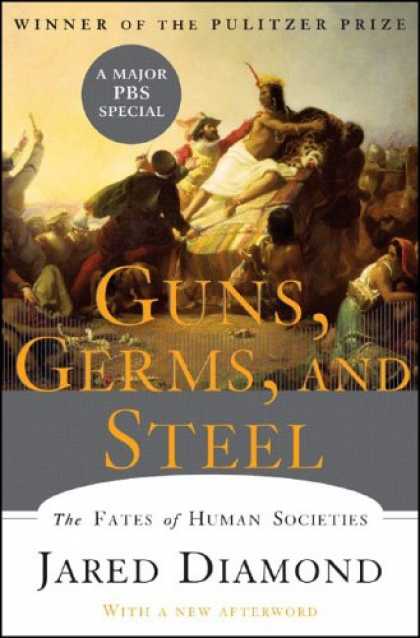
Guns, Germs, and Steel: The Fates of Human Societies-by Jared Diamond--DROPPED
When I first read the summary for this book, I thought that I would enjoy this book. However, I hardly read past the prologue because the information (about ancient civilizations) was not of my interest. This does not mean I do not like contemporary nonfiction. I enjoy the genre about topics I want to read about; for example, earlier this year, I read Fast Food Nation: The Dark Side of the American Meal, which was a fascinating, revealing book about shocking meat factory conditions. However, this has been a valuable experience: I have learned to select books more carefully to best suit my needs.

Thursday, March 25, 2010
The Glass Castle-by Jeannette Walls
The Glass Castle has been a different read for me. I noticed it while scrolling down the independent reading list suggestions. Usually, I will choose historical fiction or contemporary nonfiction. However, as part of my reading goal, I will try new genres. Sure enough, this book captivated my attention immediately because it was so vivid and shocking. All throughout the book, I was thinking, How is the family going to survive these rough, dangerous events? Yet, they remain tough and have faith in each other and eventually pull through. I could never relate to Jeannette because I live such a supported, sheltered life. I have no idea what it feels like to live out in the barren Arizona wilderness with a drunken father and neglecting mother. So towards the end of the book, when the author graduates from college and receives a generous pay from a journalist company, I was amazed that she achieved this great feat from very humble beginnings. She defines the true nature of perseverance.
Lastly, the idea of the Glass Castle tricked me. I believed that the book would be about a prosperous family in a comfortable house. However, the Glass Castle was nothing as I expected (I will not tell you--you will have to read the book to find out!). Overall, the book was a fantastic book that has opened my eyes to similar types of books.

Lastly, the idea of the Glass Castle tricked me. I believed that the book would be about a prosperous family in a comfortable house. However, the Glass Castle was nothing as I expected (I will not tell you--you will have to read the book to find out!). Overall, the book was a fantastic book that has opened my eyes to similar types of books.

Thursday, February 25, 2010
The Professor and the Madman-by Simon Winchester-Dropped Book
After I read halfway through The Professor and the Madman, by Simon Winchester, I found the book to be boring because I was not really interested with the history of the Oxford English Dictionary. I picked up the book and read it because I felt that it was a classic and I would like it. However, the book did not taint my perception of reading classics. As mentioned in the previous blog I wrote, I do enjoy classics, but not this particular book because it was too factual.


The Bluest Eye-My Reaction
I enjoyed reading this challenging, enriching book. I usually read contemporary nonfiction and historical fiction; I do not read many classics. I aim to read more classics because I would like to further my critical thinking skills. I used to think that classics sounded boring to read but after reading The Bluest Eye, I feel like reading more classics because I had advanced intellectually by conquering the Bluest Eye.


The Bluest Eye with The Awakening
The Bluest Eye, by Toni Morrison, was an extremely dense book, but I forged through it and have emerged a stronger reader and comprehender. The book was filled with vivid images and turning points of the protagonist, Pecola Breedlove, an African American girl. I chose this book because it related to two themes: hope for a better life and conformity. The first theme, hope, connects very well to The Awakening, by Kate Chopin. Pecola hopes for her eyes to turn blue so she can be recognized in the world. Fueling her desire is the presence of white, prosperous, joyous families enjoying their lives. Pecola’s ultimate goal is the hope to become white and prosperous, instead of feeling miserable and impoverished because she is black. In The Awakening, the protagonist, Edna Pontellier, hopes to free herself from the restraints placed on her by her husband and by men in society. Even though the two settings of both books are total contrasts, the idea of hope is central to both texts. However, the second theme, conformity, contrasts between the two books. Pecola wants to fit in and live like a white person in society and not feel ostracized because of her race, whereas Edna wants to non-conform and create her own path in life without assistance from any men.
I can’t wait to explore the connections and contrasts between these two classics.
I can’t wait to explore the connections and contrasts between these two classics.
Tuesday, December 29, 2009
Lone Survivor-by Marcus Luttrell
Lone Survivor forever changed my perspective on war. Just looking at the title gave me an ominous feeling that I was not going to be reading about a light-hearted topic. Sure enough, the book was packed with battle scenes from the war and very tough emotional scenes. For instance, when Marcus and his regiment of Navy Seals fought the Battle of Murphy's Ridge (named after the commander), all three of Marcus's buddies were killed in the battle. I cannot even begin to understand how depressed he must have felt. His regiment was extremely beneficial to him, providing him support and protection in an unknown, rugged terrain. However, I was extremely proud of Marcus's efforts to pull himself together and continue the mission: to find and capture a Taliban leader, Sharmak. This whole book is chock full of examples of Marcus's valor as a Navy Seal fighting in Afghanistan. I definitely cannot begin to compare myself to him, especially after reading about the tireless training.
I also chose this book because it was about Afghanistan, a country that I do not know much about in terms of geography and culture. And this book weaves the Afghan culture in with the war. Marcus actually received hospitality and shelter from the local tribesmen, under a system of lokhay. In fact, under this system, the locals promise to oppose and fight against their own countrymen (Taliban) to aid the opposition force (America).
I would rate this book a 10 out of 10 because of its exhilarating and interesting first-hand experience in the Afghan War.

I also chose this book because it was about Afghanistan, a country that I do not know much about in terms of geography and culture. And this book weaves the Afghan culture in with the war. Marcus actually received hospitality and shelter from the local tribesmen, under a system of lokhay. In fact, under this system, the locals promise to oppose and fight against their own countrymen (Taliban) to aid the opposition force (America).
I would rate this book a 10 out of 10 because of its exhilarating and interesting first-hand experience in the Afghan War.

Saturday, November 28, 2009
Completion of Fast Food Nation: The Dark Side of the American Meal--by Eric Schlosser
Having completed the book (over Thanksgiving), I am repulsed by fast food, from the production to the selling of it. Would you eat one of those big macs after reading that employees at meat plants spit on the floor and pick up dropped meat off the floor and return it to the production line? After reading this fact, I almost threw up. This book has 99.9% dissuaded me from eating at fast food restaurants from now on. These chains do not complete yearly health checkups by the federal government. The surveys are so rarely completed that in a span of ten years, a salmonella outbreak could occur and sicken thousands of people. These food chains are the most dishonest and manipulative businesses I have seen; they will do whatever means necessary to make money. They sicken me.
In the future, I hope the government will severely crack down on these corporations and curb the unscrupulous and dirty habits of the businesses and bring the fast food industry into the 21st century.


Wednesday, November 11, 2009
Writing Styles
What interests me about reading are the different styles I come across. I enjoy historical fiction novels because the facts are weaved into the fictional dialogue. However, I also enjoy contemporary nonfiction novels because once in a while, I will want to be informed about the society I live in. In Fast Food Nation: The Dark Side of the American Meal, I not only like reading about the repulsive ingredients in my fast food, but also there are secondary facts that remind me of things I learned in school. Reading these bits of information makes me proud that I could relate what I learned in school to life. Nonfiction is actually not as boring as I had once thought; if the facts are woven into real life stories, nonfiction can be quite addicting.
Friday, November 6, 2009
Behind the Scenes of Employment by Fast Food Chains
In Fast Food Nation, I was very surprised at the way fast food kitchens were operated. I walk into a McDonald's and I think that everybody is working very hard. To some degree, yes--but for a different reason. In the kitchen, almost all the equipment is automated and runs independently; all the employees have to do is to stay on schedule and scoop up the cooked food and package it. Also, the food isn't really cooked; it's frozen and just reheated and/or fried. Furthermore, most of those seemingly, happy, polite, and smiling cashiers do not smile for real. They are required to put on a facade to entice customers to spend money at the restaurant. Most of the time, since fast food employees aren't paid a lot of money, the employees may be hiding a depressing side of their personalities from customers. Also, cashiers are required to try to get customers to spend as much as possible by suggesting different foods. So, a word of critical advice: have a tough mind when you walk into a fast food restaurant and remain adamant in your orders.
Reading up to this part so far, I get the picture that fast food restaurants are not a friendly and genuine as I previously thought. Additionally, fast food chains are like the machine-like ward in One Flew over the Cuckoo's Nest because the kitchens are dominated by machines. This scene portrays a very creepy future in which mankind will be victims of machines, and controlled by them. Unless we have a way of relying less on machines, we'd better be ready for that fateful day when man falls to things.
Now that you have read all about fast food chains, I would suggest reading the whole of Fast Food Nation: The Dark Side of the American Meal in order to repulse you even more, ultimately convincing you never to eat fast food again.
Reading up to this part so far, I get the picture that fast food restaurants are not a friendly and genuine as I previously thought. Additionally, fast food chains are like the machine-like ward in One Flew over the Cuckoo's Nest because the kitchens are dominated by machines. This scene portrays a very creepy future in which mankind will be victims of machines, and controlled by them. Unless we have a way of relying less on machines, we'd better be ready for that fateful day when man falls to things.
Now that you have read all about fast food chains, I would suggest reading the whole of Fast Food Nation: The Dark Side of the American Meal in order to repulse you even more, ultimately convincing you never to eat fast food again.
Monday, October 26, 2009
Similarities to English 11 Literature
Fast Food Nation: the Dark Side of the American Meal is an addicting book. America is founded on principles such as hard work, and perseverance (American Literature themes). What I really hated myself for in retrospect was the fact that these fast food chains take advantage of kids because kids watch hours of TV and see commercials of fast food meals with toys included in them. Thus, the kids manage to convince their parents and even grandparents to go to the restaurant. If millions of kids act in this manner, the fast food chains are getting rich on kids naïveté. Not that I acted this way (I was a very gratified child), but I feel manipulated in hindsight!
This theme of hard work and perseverance connects to the American literature that we have read this year, such as “Sonny’s Blues” by James Baldwin. Sonny, an African American, grows up in Harlem hoping for a happier, more successful future instead of staying in his drug-ridden, poverty-stricken life. Sonny devotes much time and effort to achieve his dream of becoming a piano player. Eventually, his efforts pay off in the end when he is respected as a musician. In Fast Food Nation, fast food entrepreneurs invest capital to start their own businesses for one goal: to make money. And they will use any means (ruthless?) necessary to achieve their goal, if it includes money.
This theme of hard work and perseverance connects to the American literature that we have read this year, such as “Sonny’s Blues” by James Baldwin. Sonny, an African American, grows up in Harlem hoping for a happier, more successful future instead of staying in his drug-ridden, poverty-stricken life. Sonny devotes much time and effort to achieve his dream of becoming a piano player. Eventually, his efforts pay off in the end when he is respected as a musician. In Fast Food Nation, fast food entrepreneurs invest capital to start their own businesses for one goal: to make money. And they will use any means (ruthless?) necessary to achieve their goal, if it includes money.
Tuesday, October 20, 2009
Genghis the Resolution; Fast Food Nation: the Dark Side of the American Meal
In the final entry of Genghis: Lords of the Bow, I would like to comment on the book in general. I would rate this book a 10 out of 10 because this was the most exciting book I ever read. I enjoy reading about history (this book was actually more accurate than I previously thought), especially about these Asian empires because not much emphasis is placed on them in history courses. I feel that in global history courses, we should spend equal time on Asian empires as we spend on the western empires. The peoples of Asia influence the future of this world as much as the western peoples did; in fact, Asian countries, such as India, China, South Korea, and Japan, have economies that are surpassing the western ones (they survive the economic downturn better than we). Because of this fact, Asia definitely needs a more prominent position in the history textbooks.
I found the first few pages of Fast Food Nation: the Dark side of the American Meal a very captivating, contemporary novel. I always knew fast food was loaded with sugar, salt, cholesterol, trans-fat, and so many other “death” ingredients, but I would like to investigate deeper into the origin of our dependence on fast food. Hopefully, while reading this book, I will be grossed out, yet so intrigued, that I will almost never want to eat fast food again for the rest of my life, if I have a choice of what to eat.
I found the first few pages of Fast Food Nation: the Dark side of the American Meal a very captivating, contemporary novel. I always knew fast food was loaded with sugar, salt, cholesterol, trans-fat, and so many other “death” ingredients, but I would like to investigate deeper into the origin of our dependence on fast food. Hopefully, while reading this book, I will be grossed out, yet so intrigued, that I will almost never want to eat fast food again for the rest of my life, if I have a choice of what to eat.
Friday, October 16, 2009
Genghis Lords of the Bow (Battle Scene)
In Genghis: Lords of the Bow, Genghis and his Mongol army confront the thousand-warrior Chin army. The Mongols are severely outnumbered and will exit the mountain pass and be in full view of the Chin army. All the Mongols have on their side as an advantage is their incredible bow and arrow shooting. This battle to come is similar to the Ancient Greek battle of Thermopylae during the Persian Wars. 300 Greeks held off thousands of Persians in a narrow mountain pass. The Greeks would have won had it not been for help from fellow Greeks who showed the Persians around the pass and surrounded the 300 soldiers. The Greeks showed immense valor trying to fight off all the Persians, even though they lost. So in this battle of the Mongols versus the Chin people, the Mongols should fight hard and to the death in honor of their tribe.


Wednesday, October 7, 2009
Genghis Lords of the Bow: Heated Decision
Genghis Khan faces a dilemma that may end up costing him many of his warriors’ lives. After a miserable, debilitating, dehydrating trudge through the Gobi desert, the Mongols reach the Xi Xia tribe. Genghis knows the one of the only successful methods of conquering this tribe is to cleverly lure the warriors out. The fort is heavily defended with archers on constant vigil. The khan (supreme ruler) of the tribe investigates a little box left behind by the Mongol warriors as they retreat (part of the plan). Birds fly out of the box, the signal for the Mongols to attack again. This scene is significant because even in the 1200s, human nature is not much different than today. The khan is just as curious and maybe even as greedy (he thinks there is gold and silver in the box) as humans are today. The Mongols break into the fort, despite losing many lives. The Mongols eventually conquer the fort and replenish badly depleted supplies, such as water.
The huge dilemma is when Mongol scouts venture to the actual village. The civilization is well-defended with archers ready to fire arrows at any invaders. Genghis ignores the suggestion of turning back to the desert because their water supplies are nearly gone. They had made the treacherous journey across the desert and now do not want the journey to be a waste. Genghis feels confident that they will be able to overtake the Xi Xia, and soon, before the Xi Xia could gather alliances from the equally fortified Chin civilization. As leader of the Mongols, he remains focused on his goals to unite all the north Asian nomadic tribes into one unified force. He is not known to retreat in shame because a difficult tribe is difficult to take over—he trains his warriors more to make them better fighters.

The huge dilemma is when Mongol scouts venture to the actual village. The civilization is well-defended with archers ready to fire arrows at any invaders. Genghis ignores the suggestion of turning back to the desert because their water supplies are nearly gone. They had made the treacherous journey across the desert and now do not want the journey to be a waste. Genghis feels confident that they will be able to overtake the Xi Xia, and soon, before the Xi Xia could gather alliances from the equally fortified Chin civilization. As leader of the Mongols, he remains focused on his goals to unite all the north Asian nomadic tribes into one unified force. He is not known to retreat in shame because a difficult tribe is difficult to take over—he trains his warriors more to make them better fighters.
Thursday, October 1, 2009
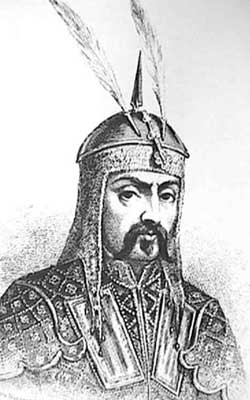
"Genghis Lords of the Bow"--by Conn Iggulden
Genghis Lords of the Bow, by Conn Iggulden, is an exciting portrayal of the Mongols’ influence on the world during the 1200s. Genghis Khan built a huge empire ranging from Eastern Europe to China and South to India (almost all of Asia!). The Mongol warriors relied on small, but strong mongolian ponies, training toughly by using bow and arrow while riding fast and drinking their horses’ blood for quick sustenance. With these relatively primitive tactics, along with looting nearby settlements for supplies, they created a huge empire that should be recognized in the history textbooks more because the Mongols really changed history.
In writing the novel, Conn Iggulden may have hoped to make the Mongols’ impact on the world more known to people because without the Mongols’ influence, our world (especially Asia) may not be as diverse as it is now. When Genghis ruled, his leadership was strong and ruthless to maintain stability, but he allowed incredible toleration for other races and religions! He ensured a safe trading along the Silk Road, previously infested with ambushing barbarians and pirates. All these actions encouraged a cultural diffusion boom with different peoples, especially a mix between European and East Asian cultures. Can you imagine what the world would be like if the Europeans never had had contact with East Asia? Mixed European/East Asian races would not exist. Our world would be boring and plain; there would be less cultural interaction we see in Asia today. Asian continental trade would not be as vast as today’s diverse trade network.
If not for Genghis Khan, say ‘Goodbye’ to your present lifestyle. Without Genghis, a brutal ruler could have arisen to power and terrorized the world for an indeterminate amount of time.
In writing the novel, Conn Iggulden may have hoped to make the Mongols’ impact on the world more known to people because without the Mongols’ influence, our world (especially Asia) may not be as diverse as it is now. When Genghis ruled, his leadership was strong and ruthless to maintain stability, but he allowed incredible toleration for other races and religions! He ensured a safe trading along the Silk Road, previously infested with ambushing barbarians and pirates. All these actions encouraged a cultural diffusion boom with different peoples, especially a mix between European and East Asian cultures. Can you imagine what the world would be like if the Europeans never had had contact with East Asia? Mixed European/East Asian races would not exist. Our world would be boring and plain; there would be less cultural interaction we see in Asia today. Asian continental trade would not be as vast as today’s diverse trade network.
If not for Genghis Khan, say ‘Goodbye’ to your present lifestyle. Without Genghis, a brutal ruler could have arisen to power and terrorized the world for an indeterminate amount of time.

Thursday, September 24, 2009
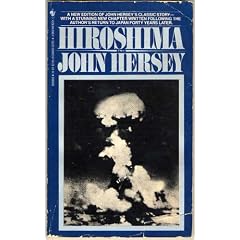
Hiroshima-by John Hersey
This book is very gruesome, but vivid and accurate. Author John Hersey investigates Japan during and the months after the atomic bomb explosion on Hiroshima. A part that really shocked me was the part, after the explosion, a survivor was helping a woman move away from a flooding river. He was pulling her arms when suddenly her skin fell right off. I had an image of exposed muscles and blood vessels. I never expected this. So not only are the initial flash burns from the bomb severe, but all the health issues after the explosion are just as horrible.
Thinking as positively as I could about this situation, I was cheering all the survivors’ valor. For example, as weak as Dr. Sasaki was, he managed to treat thousands of patients at the Red Cross Hospital, until he was forced to sleep minimal hours. I have no idea how it feels to work continuously for 3 days straight WITHOUT sleeping. Praise him!
In American History courses, much more time should be devoted to the explosion of the atomic bomb and the after effects. We skim over how the Japanese were affected; instead, we should look at more case studies of specific people or of specific ways the people were affected in DETAIL! Since we dropped the bomb, we should fully understand the repercussions and what we caused by dropping the bomb; families were instantly torn apart. A traditional, bustling economy was instantly transformed to ashes when the bomb detonated at 8:15 am (local time) August 6, 1945. In short, by dropping the bomb, we saved thousands of American soldiers’ lives which otherwise may have died in an extension of the war, but we must remember that by saving our lives, we killed thousands of possibly innocent Japanese civilians.
Sunday, September 13, 2009
Flags of our Fathers-by James Bradley
Flags of our Fathers, by James Bradley, is a non-fiction book that accurately depicts the fighting of the U.S soldiers against the Japanese soldiers in World War II, specifically during the Battle of Iwo Jima, one of the Japanese strongholds in the Pacific. The mountainous terrain and the technology of rapid machine gun fire made the fighting almost impossible to win. As I read the book, I was horrified by the savage techniques used by the U.S. The soldiers had to resort to flame throwers in order to kill and slowly conquer the island. In any other war, using fire would have been over-the-top but in this war, since the Japanese were hiding and shooting from underground tunnels, the U.S had to use whatever they could think of to drive the Japanese out. This book is full of valorous moments, especially with the corpsmen running through cross-fire to save wounded soldiers. If I ever had to fight in a war because of a draft, I would do my duty to my country but I probably would be too scared to attempt anything extra--especially saving others’ lives. I would rate this book a 10 out of 10 because of the high amount of patriotism (especially the climax when raising the U.S flag on the highest point of Iwo Jima under surprise ambushes) of the soldiers. Anyone who loves war and history books, Flags of our Fathers is for you.

Subscribe to:
Posts (Atom)